
The Question of Motive
ARCHIVE 001 · A DEVELOPING DOCUMENTARY RECORD
A home. A personal inquiry. The decisions that followed.
When Personal Interest Meets Institutional Power
On August 20, 2024, Stacie Branch contacted Greg by text about buying his riverfront home. Greg says they had no prior personal relationship, his phone number was not publicly listed, and he had never given it to her, nor does he know of anyone who shared it with her. How Branch obtained his number remains unknown.
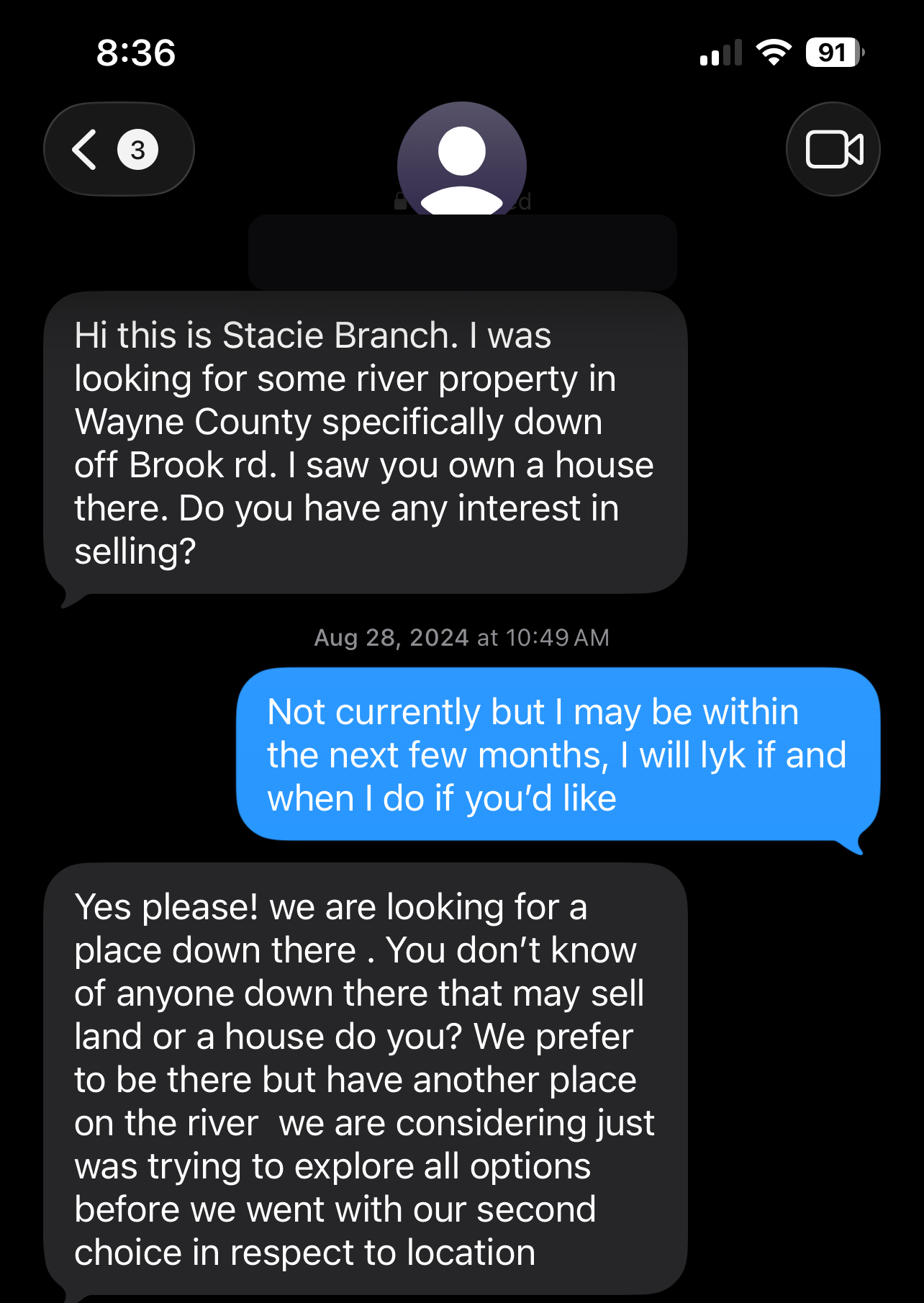
On August 20, 2024, Greg received a text beginning, “Hi this is Stacie Branch.” The sender said she was looking for river property in Wayne County and asked whether he had any interest in selling. He preserved screenshots of that exchange. They show his August 28 reply: “Not currently but I may be within the next few months, I will lyk if and when I do if you’d like.”
Greg declined a sale at that time, while leaving open the possibility of a future conversation. The reply was friendly: “Yes please!” The sender mentioned another river property under consideration and asked about other potential sellers. Greg offered to check with his neighbor.
For Greg, this was a conversation about his home with the person leading the institution to which he owed money. Later, Interstate Credit Union repossessed his 2015 Ford F-150 and sold it for $700. Its own records show a historical title odometer reading of 63,819 miles, but a J.D. Power valuation input of 226,707 miles—a difference of 162,888 miles and a $7,260 mileage deduction. The institution then brought a lawsuit containing allegations it would subsequently contradict in its own discovery responses. See the truck →
The question is whether those two relationships—the personal interest in Greg’s property and the institutional handling of his debts—ever intersected in a decision.
Source: preserved August 2024 message screenshots
The same week, another decision
Two loan modifications dated May 31, 2024 bear Branch’s electronic signature as loan officer and extend repayment terms. The modifications are part of the account history; they do not, by themselves, establish when repossession or other enforcement action began.
On July 31, Greg emailed collection manager Denison about two nonrunning vehicles pledged to the credit union: an older Cadillac and a 1998 Ford pickup. He was moving from a rental property and needed the vehicles moved. He proposed a scrap buyer who would pay $250 for each vehicle, with the full $500 applied to the loan. He asked the credit union to obtain the paper titles and authorize the sale, and said he intended to continue making payments.
On August 22, photographs of the vehicles were forwarded to Denison, with a report that the vehicles had been moved out from under the carport so the buyer could collect them. This was an effort to arrange their disposal and reduce the debt. The correspondence does not establish a completed sale or an accepted, unconditional surrender to Interstate.
An August 27 email from Denison, preserved in a later forward, asked that the photographs be resent so she could show them to Stacie “so she can make a decision.” Interstate’s collection notes also record pictures sent to Stacie that day. Those records identify a route toward Branch for a collateral decision during the same period as the house exchange. They do not establish what she received, what she decided, or whether any decision followed Greg’s reply about the house.
Neither older vehicle was repossessed or sold by Interstate Credit Union, as the institution has now formally admitted. As a result, both vehicles remained in Greg’s possession, leaving him with the continuing burden of storing them.
Sources: July–August correspondence and collection notes
The truck, the sale, the lawsuit
Interstate Credit Union repossessed Greg’s 2015 Ford F-150 on June 27, 2025, according to its records. A letter dated June 26 gave him until July 1 to pay the overdue amount—four days after the repossession. The sequence raises a question about the recovery process; the letter and dates alone do not resolve the credit union’s contractual authority.
In his proposed pleading, Greg describes visiting the dealership with his son and discovering that his 2015 Ford F-150 was missing. His initial concern was that the truck might have been stolen. When he contacted the dealership the following day, the service advisor told him he was holding the truck's keys in his hand but did not know where the vehicle was. The advisor said he would investigate but never contacted Greg again. Greg later learned that Interstate Credit Union had repossessed the truck when the repossession appeared on his credit report, after the vehicle had already been sold.
On November 19, 2025, collections officer Jonathan Hunt sent Branch an email titled “Vehicles Needing Work.” He described mechanical problems, estimated repairs at $14,593.63, and projected an unrepaired sale price of $1,000–$1,500. He recommended selling the truck for junk. Interstate Credit Union’s own J.D. Power worksheet used 226,707 miles, while its own title record contained a historical odometer reading of 63,819 miles—a difference of 162,888 miles. The higher worksheet input produced a $7,260 mileage deduction. The historical title reading is not proof of the mileage on the sale date; the provenance and accuracy of the higher input remain disputed.
Interstate’s sale record dates the truck’s $700 sale to January 8, 2026. A $700 credit also appears in the account records. The dispute concerns how the truck was valued, offered, and sold, who authorized the transaction, and the amount Interstate may lawfully recover afterward. See the truck →
Branch signed a sworn verification on March 18, 2026, affirming that the facts alleged in Interstate’s original complaint were true and correct. The complaint was filed the next day. It alleged that the vehicles had been repossessed, disposed of, and their proceeds applied to the debt.
On September 22, Interstate admitted that it had never repossessed or sold the Cadillac or the 1998 Ford. Its September 25 amended complaint identified only the 2015 truck as repossessed. The change is documented. Why the original account was asserted, what Branch knew when she verified it, and how the error was addressed remain questions for evidence and testimony.
Compare the collateral records · Read Branch’s verification · Read the amended complaint
Following the Decisions to Stacie Branch
A lender’s decisions about collateral and collection can change a borrower’s financial circumstances. When its chief executive also wants to buy the borrower’s property, it becomes reasonable to examine whether that personal interest was disclosed and kept separate from those decisions.
Branch’s title alone cannot supply that answer. Here, the record contains specific connections: the August 2024 referral concerning the older vehicles, Hunt’s November 2025 email about the truck, and her March 2026 sworn verification. Each connection has a different meaning. A referral does not establish an instruction; an addressed email does not establish approval; a verification establishes what she affirmed, while leaving the information she reviewed to be examined.
Greg’s proposed counterclaims place Branch’s interest in his riverfront home within the chronology of Interstate Credit Union’s collection and litigation conduct. Greg asserts that Branch’s personal interest in acquiring his property was the motive behind the treatment he subsequently experienced. The reviewed record does not contain a communication tying a collection decision to Greg’s willingness to sell it.
Was the conduct intentional from the beginning?
Greg’s central theory is that the challenged treatment began with knowledge and intent, connected to Branch’s personal interest in his home. Testing that theory requires following the earliest source records into each decision: the handling of the collateral, the preparation of the debt allegations, and the verification and filing of the original complaint.
What did Stacie Branch and Samantha Jacobs know before filing? Who supplied, checked, or authorized the repossession and disposition account? Which contemporaneous records were available, and do they support or contradict the representations made? The later admissions sharpen those questions. The subsequent record also tests who learned of inaccuracies, what opportunities existed to correct them, and whether later decisions show coordinated conduct.
The investigation keeps the original knowledge inquiry and the later correction history connected. Each requires evidence of the participants’ information and actions, alongside the explanations they offer.
Following the record forward
The accounting has its own correction history. In its September 22 response to Request for Admission No. 66, Interstate Credit Union stated: “Alleged deficiency amount may be incorrect and is being worked on with Christy.” In an October 9 revised response, Interstate attributed the review to a third loan omitted from the original complaint and said it had not intended to concede an incorrect amount. Greg contests that revision. Both versions belong in the record. Neither, by itself, establishes a motive.
On October 11, Greg filed a superseding request for permission to submit further amended counterclaims. The attached proposed pleading includes the property contact in paragraph 22 and develops claims concerning collateral handling, accounting, alleged misrepresentation and concealment, contract obligations, and alleged wrongful repossession. The further amendment is proposed and awaiting judicial consideration in the materials reviewed for this page. Its allegations are Greg’s claims, not judicial findings.
The investigation follows decisions: what information was available before the original lawsuit, who received it, what was checked, and what happened after inaccuracies were brought to attention. It also follows the missing links between a recommendation and an authorization, between a document and the person who relied on it.
This account concerns Greg Moore, the Defendant/Counterclaim Plaintiff in Interstate Credit Union v. Moore. The property screenshots and Greg’s descriptions of events preserve his account; the credit union’s records, pleadings, and admissions provide other parts. The materials reviewed here contain no judicial determination that the property interest caused the challenged treatment.
The litigation continues. So does the work of establishing who knew what, when, and what followed.
Would Interstate Credit Union have treated me the same way if I had agreed to sell its president and CEO my riverfront home?
Sources and verification
Property exchange. Preserved screenshots: Stacy_branch_1.PNG and Stacy_branch.PNG; displayed August 20, 2024, 2:10 p.m. and August 28, 10:49 a.m. Self-identification and Greg’s attribution; native thread and independent authorship confirmation remain outstanding.
Older-vehicle proposal. July 31, 2024 sent email to Denison; August 22 photo correspondence, Fwd- Car pictures for Gregory Moore.pdf, pp. 1–9; August 27 Pictures email preserved in October 8, 2026 forward. DOCS 251 records the referral. The displayed times do not establish the exact dispatch sequence.
Loan modifications and account records. G. Moore responses- docs.pdf: DOCS 223 and 239 (May 31 modifications); DOCS 247, 249–251 (collection history and April cancellation); DOCS 152–153 (June 26 letter and July 3 notice). DOCS are production PDF page numbers.
Truck disposition. G. Moore- icu discovery.pdf, pp. 31–33 (November 19 Hunt email) and 43–46 (recovery and sale records). Hunt’s estimates are attributed statements, not independent mechanical findings. See the Archive’s existing comparison. Read the supporting record.
Original allegations. Original complaint, March 19, 2026, paragraphs 11–13; Branch’s verification, signed March 18 and filed March 19. Read the supporting record.
Admissions and changed allegations. September 22 responses: RFAs 8–9 and 21–22; RFA 66 on p. 7. September 25 amended complaint, paragraph 16. Read the supporting record.
Interstate’s revised explanation. October 9, 2026 First Amended Response, Request 66 only, pp. 1–2; source also preserved in October9_RFA66_FILESTAMPED.pdf, pp. 15–16. Both response versions were reviewed.
Proposed further counterclaims. October 10 named package filed October 11, 2026, 11:19 a.m., Peach E-EJZYFCBJ. Exhibit A, paragraphs 18–22, 23–38, 67–118. Signed submission copy and file-stamped copy preserved; October 12 acceptance email independently checked. The public redacted excerpt includes the motion and complete proposed Exhibit A; Exhibit B is withheld. Read the supporting record.
Record reviewed October 12, 2026.